Find the Best Grease Trap Cleaning Companies for Your Business
No obligation • Fast responses • Nationwide coverage

Why you can trust Restaurant Waste Disposal
Restaurant Waste Disposal is a leading U.S. resource for comparing restaurant composting, food-waste recycling, grease trap cleaning, and used cooking oil collection services. Our editorial team researches providers, checks credentials, and organizes unbiased information so operators can make informed decisions. Companies cannot pay to change ratings or placement.
Search providers near you
Top Grease Trap Cleaning Companies in West Des Moines, Iowa Ranked
For any restaurant or food service business in West Des Moines, maintaining a clean and compliant grease trap or interceptor is not just a best practice-it's a legal requirement enforced by local authorities. Proper grease trap maintenance is critical for preventing costly sewer blockages, avoiding significant fines, and protecting the public wastewater infrastructure. In West Des Moines, these regulations are managed by the Des Moines Metropolitan Wastewater Reclamation Authority (WRA), which has specific rules governing how and when your grease control device must be serviced. Understanding these local mandates, from cleaning frequency to required documentation, is essential for the smooth operation of your commercial kitchen and for safeguarding your business from compliance issues.
Waste Solutions of Iowa (WSI)
5554 NE 14th St, Des Moines, IA 50313
Waste Solutions of Iowa (WSI) is a woman-owned business based in Des Moines, IA, offering a range of temporary sanitation and waste management solutions. Their services include portable toilet rentals, hand wash stations, roll-off dumpsters, grease trap pumping, and solar-powered surveillance trailers. WSI serves events, construction sites, restaurants, and businesses throughout the Des Moines area. They specialize in scheduled grease trap pumping to help foodservice businesses comply with local regulations and maintain efficient drainage. Established in 1982, WSI has over 40 years of experience and provides 24/7 video surveillance options for enhanced security at events and job sites.
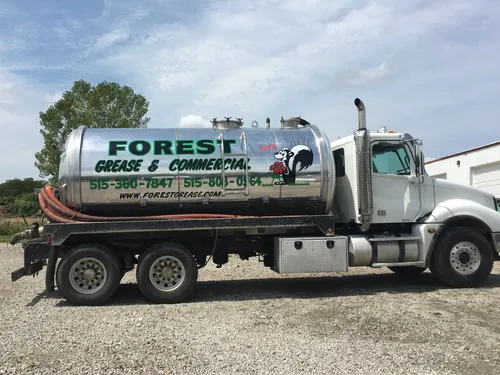
Forest Grease & Commercial
Des Moines, IA
Forest Grease & Commercial is a grease trap cleaning company serving Des Moines, IA, and Central Iowa. Established in 1918, the company focuses on commercial and industrial wastewater treatment solutions, helping food service establishments comply with the local Fats, Oils, and Grease (FOG) Ordinance. Their services include cleaning grease traps and interceptors, as well as pumping various types of commercial liquid waste and cleaning commercial pits such as car wash and maintenance bay pits. Forest Grease & Commercial has a long history of serving both commercial and residential clients, now concentrating solely on industrial and commercial customers.
Understanding Local Grease Trap Regulations
The cornerstone of compliance in West Des Moines is the Fats, Oils, and Grease (FOG) Rule enforced by the WRA. This isn't a suggestion; it's a codified set of requirements designed to keep grease out of the public sewer system. The local plumbing code mandates that owners maintain these interceptors in an efficient operating condition and ensure they are readily accessible for inspection, pumping, and cleaning. The WRA conducts routine inspections of grease traps, checking the physical condition of baffles and the integrity of the unit itself, while also reviewing your maintenance records. If a history of non-compliance or a sewer blockage is traced to your establishment, you can expect more frequent, non-routine inspections 1. Violations of these rules can lead to enforcement actions, including fines, making proactive adherence a financial imperative.
Mandatory Cleaning Frequency and Triggers
You cannot simply clean your grease interceptor when you remember or when it seems full. The WRA has a clear, measurable standard. Service is legally required when the accumulated FOG depth reaches 25% of the liquid depth of the trap or on a quarterly basis (every three months), whichever comes first 2 3. This "whichever comes first" clause is crucial-a busy establishment may hit the 25% threshold well before three months have passed. Relying on a calendar schedule alone could put you out of compliance. Regular monitoring of your interceptor's contents is therefore a necessary part of your kitchen's operational checklist to determine the correct service interval for your specific volume of wastewater.
The Proper Cleaning and Pumping Process
Not all pumping services are created equal, and the WRA specifies what constitutes a proper cleaning. Simply removing the liquid layer is insufficient. A compliant service must remove all contents, including the floating grease mat (scum layer) and the settled solids (sludge layer) from the bottom of the trap 4. Furthermore, the use of emulsifiers, enzymes, or other chemical agents that liquefy grease to pass it through the trap is typically prohibited, as these substances simply move the problem downstream where the grease can re-solidify and cause blockages in the public sewer 4. All waste removed must be transported and disposed of at approved facilities, with the service provider providing documentation of this proper disposal.
The Critical Role of Recordkeeping
If you service your trap but fail to document it, you might as well have not done it in the eyes of an inspector. Maintaining detailed records is a non-negotiable part of the WRA's FOG program. You are required to keep logs for a minimum of three years. These records should include:
- The date of each pumping or cleaning service.
- The volume of grease and solids removed (in gallons).
- The name and license of the service provider who performed the work.
- The disposal location or manifest number proving proper waste handling. Having these records organized and readily available during a WRA inspection is your primary evidence of compliance and can help you avoid penalties.
Find the perfect grease trap cleaning companies for your needs
Get personalized recommendations and expert advice
Cost Considerations for Service in West Des Moines
While compliance is paramount, understanding the cost structure for grease interceptor maintenance helps in budgeting. Costs are not fixed and can vary based on your trap's size, the amount of accumulated FOG, and your agreed service frequency. For a standard, scheduled pumping and cleaning service, businesses can generally expect costs in the range of $250 to $400 per service visit 5 6. However, these are baseline estimates. Emergency calls, which may be necessitated by a clog or an unexpected inspection failure, can cost significantly more-potentially ranging from $800 to $1,200 or higher due to after-hours rates and expedited service needs 5 7. Investing in a regular, preventative maintenance schedule is almost always more cost-effective than reacting to an emergency or paying a fine.
Consequences of Non-Compliance
Failing to adhere to West Des Moines' grease trap regulations carries tangible risks for your business. The most immediate consequence is financial penalties from the WRA for violations 8. Beyond fines, a severely neglected trap can lead to sewage backups within your own establishment, resulting in operational shutdowns, costly interior plumbing repairs, and potential health code violations. On a broader scale, FOG discharged into the sewer system contributes to blockages in the city's infrastructure, which can lead to sanitary sewer overflows (SSOs)-environmental hazards that communities work hard to prevent. Your diligent maintenance is a key part of protecting both your private property and the public utility system 8.
Choosing a Service Provider for Compliance
Selecting the right partner for your grease interceptor pumping is a strategic business decision. Look for a licensed, insured provider with proven experience servicing commercial accounts in the Des Moines metro area. They should be thoroughly familiar with WRA regulations and be able to explain the compliance process clearly. A reputable provider will not only perform the physical cleaning to standard but will also supply you with the detailed documentation (service tickets, disposal manifests) you need for your records. They can often advise on optimal service frequency based on your trap size and kitchen output, helping you stay ahead of the 25% threshold and avoid emergency scenarios.
Frequently asked questions
Sources
Footnotes
-
101.08 OPERATION, MAINTENANCE AND CLEANING OF GREASE ... - https://codelibrary.amlegal.com/codes/ankeny/latest/ankeny_ia/0-0-0-3530 ↩
-
Essential Grease Trap Maintenance For Des Moines Facilities - https://www.myshyft.com/blog/grease-trap-cleaning-des-moines-iowa/ ↩
-
7-8B-5: GREASE TRAPS AND INTERCEPTORS REQUIRED: - https://codelibrary.amlegal.com/codes/westdesmoinesia/latest/westdesmoines_ia/0-0-0-50308 ↩
-
Grease Trap and Interceptor Pumping and Cleaning | Des ... - https://synergyfire.net/grease-interceptor-trap-services/ ↩ ↩2
-
Ultimate Grease Trap Pumping Cost Guide: Essential Money-Saving ... - https://www.texwaywastewater.com/grease-trap-pumping-cost/ ↩ ↩2
-
How Much Does a Proper Grease Trap Cleaning Cost? - https://hulseyenvironmental.com/how-much-does-a-proper-grease-trap-cleaning-partner-cost/ ↩
-
Grease Trap Cleaning Prices | Guide on the Industry Average - https://grease-cycle.com/grease-trap-pumping-cost/ ↩
-
The Essential Role Of Grease Trap Cleaning In Iowa's ... - https://wastesolutionsofiowa.com/blog/the-essential-role-of-grease-trap-cleaning-in-iowas-commercial-kitchens/ ↩ ↩2