Find the Best Composting & Food Waste Companies for Your Business
No obligation • Fast responses • Nationwide coverage

Why you can trust Restaurant Waste Disposal
Restaurant Waste Disposal is a leading U.S. resource for comparing restaurant composting, food-waste recycling, grease trap cleaning, and used cooking oil collection services. Our editorial team researches providers, checks credentials, and organizes unbiased information so operators can make informed decisions. Companies cannot pay to change ratings or placement.
Search providers near you
Top Composting & Food Waste Companies in Santa Clara, California Ranked
For restaurants and food service businesses in Santa Clara, managing organic waste is no longer just an environmental consideration-it's a state-mandated requirement. California's SB 1383 has transformed food scrap recycling from a voluntary best practice into a core operational necessity for all commercial entities generating organic waste. This regulation is designed to dramatically reduce landfill emissions by diverting food scraps, food-soiled paper, and yard trimmings to composting or anaerobic digestion facilities. For business owners, this means implementing a systematic approach to separating organics, understanding the specific services offered by the city's franchised haulers, and training staff to maintain compliance. Successfully navigating these requirements can not only avoid potential penalties but also uncover opportunities for cost savings through waste reduction.
Understanding SB 1383: The Mandate Behind the Movement
The foundation of Santa Clara's organic waste recycling program is California Senate Bill 1383. This landmark legislation sets ambitious targets to reduce statewide disposal of organic waste by 75% from 2014 levels by 2025 1 2. For businesses, including every restaurant, cafe, grocery store, and hotel kitchen in Santa Clara, this translates into two primary obligations:
- Mandatory Organics Separation and Recycling: All businesses that generate organic waste must subscribe to and properly use an organics collection service. You cannot simply throw food scraps in the trash.
- Edible Food Recovery: Larger commercial edible food generators, such as supermarkets and large restaurants, have additional requirements to recover and donate surplus edible food to local recovery organizations 3.
The City of Santa Clara and Santa Clara County enforce these rules, with the goal of capturing valuable organic material to create compost or renewable energy, rather than letting it decompose in landfills where it produces potent methane gas.
Who is Required to Comply?
Virtually all food service businesses in Santa Clara must participate in organics recycling. However, there is a potential exemption. A de minimis waiver may be available for businesses that can demonstrate they generate a very small amount of organic waste-typically less than 10 gallons (or 20 pounds) per week 4 5. Qualifying for this waiver involves an application process through the county. For the vast majority of restaurants, even small ones, subscribing to an organics collection service is the standard and required path forward.
Setting Up Your Commercial Organics Program
Implementing a compliant food waste diversion system involves coordinating with your hauler, selecting the right equipment, and establishing clear internal procedures.
Working with Franchised Haulers
In Santa Clara, commercial waste collection is provided by franchised haulers assigned to specific zones. Mission Trail Waste Systems is the primary hauler for most city areas, while other providers may service specific industrial zones. Your first step is to contact your designated hauler to set up or modify your service. They will provide the necessary containers and establish a pickup schedule based on your volume and needs, which can range from daily to weekly service.
Container Types and Colors
Standardization is key for reducing contamination. The state has established color-coded container systems:
- Green Containers: Designated for source-separated organics. This includes all food scraps and food-soiled paper 6.
- Gray or Black Containers: For trash destined for the landfill.
- Blue Containers: For traditional mixed recyclables like cans, bottles, and clean cardboard.
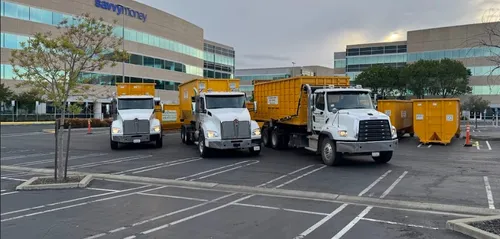
For commercial clients, containers come in various sizes beyond standard carts. Options include larger wheeled carts, compactors, and roll-off containers ranging from 10 to 40 cubic yards for high-volume locations. Your hauler can help you choose the right size and combination to manage organics, recycling, and trash efficiently.
What Goes In the Green Organics Bin?
Clear guidelines are essential for staff training and preventing contamination, which can spoil entire loads of compostable material.
YES - Acceptable Organics:
- All food scraps: fruits, vegetables, meat, bones, dairy, bread, and plate scrapings.
- Coffee grounds and filters.
- Food-soiled paper products: napkins, paper towels, parchment paper.
- Food-soiled cardboard: pizza boxes (with food residue), greasy take-out containers (if paper-based), and waxed cardboard.
NO - Contaminants (Place in Trash or Recycling):
- Plastic bags (unless they are certified compostable and your hauler specifically accepts them).
- Plastic utensils, wrappers, or packaging.
- Styrofoam.
- Glass, metal, or aluminum foil.
- Liquids, oils, or grease.
- "Biodegradable" or "degradable" plastics that are not certified compostable 7 8.
Find the perfect composting & food waste companies for your needs
Get personalized recommendations and expert advice
Operational Best Practices for Restaurants
A successful organics program relies on seamless integration into daily kitchen and front-of-house operations.
Start with Source Separation: Place small, clearly labeled collection pails (often with a liner) in key prep areas, dish pits, and behind service counters. This makes it easy for staff to separate food scraps at the point of generation, rather than sorting through trash later.
Train and Communicate: Conduct regular training sessions for all employees, including new hires. Use the signage provided by your hauler or the city, which is required to be posted in customer and staff areas, to reinforce what goes where. Make sure cleaning crews also understand the system.
Manage Grease and Cooking Oil Separately: While used cooking oil is an organic material, it is typically collected under a separate service agreement for recycling into biodiesel. Grease trap waste is also handled by specialized services. These streams are not part of the standard green bin organics collection.
Monitor and Adjust: Track how quickly your organics, recycling, and trash containers fill up. If your green bin is consistently full while your trash bin is half-empty, you may be able to downsize your trash service frequency or container size, which can lead to cost savings.
Cost Considerations and Potential Savings
The financial aspect of organics recycling is a common concern for business owners. Costs are not fixed and depend entirely on your service configuration.
Service-Based Pricing: Your monthly bill from your hauler (e.g., Mission Trail) is typically a bundled rate covering trash, recycling, and organics collection. The cost is influenced by:
- The size and type of containers (cart, compactor, roll-off).
- The frequency of pickup for each stream.
- The specific location and access requirements 9 10.
The Reduction Opportunity: A key strategy for managing costs is waste reduction. By diligently separating organics and recyclables, you reduce the volume of material going into your trash (landfill) bin. Since landfill disposal is often the most expensive component of your waste bill, you can potentially lower your overall cost by requesting a smaller trash container or less frequent trash pickup 11. The city and county encourage this waste hierarchy: reduce first, then donate edible food, then recycle organics, with landfill as the last resort 12.
Rate Changes: It's important to note that recent rate adjustments for commercial solid waste services reflect the costs haulers incur to comply with SB 1383, including new processing fees for organic material 13. Contacting your hauler directly for a custom waste analysis is the best way to get accurate pricing and explore service options tailored to your business 14.
Beyond the Bin: Edible Food Recovery
For qualifying businesses, SB 1383's edible food recovery requirement adds another layer. This involves establishing a relationship with a local food bank or recovery agency to schedule pickups of surplus, wholesome food 15. This not only fulfills a regulatory requirement but also provides meaningful support to the community. Resources are available through Santa Clara County to help connect businesses with recovery organizations.
Frequently asked questions
Sources
Footnotes
-
Statewide Mandatory Organic Waste Collection - CalRecycle - CA.gov - https://calrecycle.ca.gov/organics/slcp/collection/ ↩
-
What is SB 1383? | Integrated Waste Management | County of Santa Clara - https://reducewaste.santaclaracounty.gov/recycling-and-organics-regulations/what-sb-1383 ↩
-
Mandatory Organics Recycling & Edible Food Recovery - https://www.santaclaraca.gov/our-city/departments-g-z/public-works/environmental-programs/commercial-and-industrial-garbage-recycling/mandatory-organics-recycling-edible-food-recovery ↩
-
Santa Clara County De Minimis Waiver Application - CalRecycle - https://www2.calrecycle.ca.gov/Docs/Web/129180 ↩
-
What is SB 1383? - Integrated Waste Management - https://reducewaste.santaclaracounty.gov/recycling-and-organics-regulations/what-sb-1383 ↩
-
Collection Systems, Container Colors, and Labeling - CalRecycle - https://calrecycle.ca.gov/organics/slcp/collection/systems/ ↩
-
Mixed Waste Processing - https://www.santaclaraca.gov/our-city/departments-g-z/public-works/environmental-programs/residential-garbage-recycling/mixed-waste-processing ↩
-
Food Waste Guide - Integrated Waste Management - https://reducewaste.santaclaracounty.gov/food-waste-guide ↩
-
Commercial and Industrial Garbage & Recycling - https://www.santaclaraca.gov/our-city/departments-g-z/public-works/environmental-programs/commercial-and-industrial-garbage-recycling ↩
-
city of santa clara development guidelines for solid waste services - https://www.santaclaraca.gov/home/showdocument?id=63246 ↩
-
Bellingham Residential Recycling and Waste Collection Services - https://cob.org/services/environment/solidwaste/waste-changes-faq ↩
-
Waste Reduction | City of Santa Clara - https://www.santaclaraca.gov/our-city/sustainable-santa-clara/waste-reduction ↩
-
Commercial Solid Waste Rates - City of Santa Clara - https://www.santaclaraca.gov/our-city/departments-g-z/public-works/environmental-programs/commercial-and-industrial-garbage-recycling/commercial-solid-waste-rates ↩
-
COMMERCIAL PROGRAM DETAILS - Mission Trail Waste Systems - https://missiontrail.com/santaclara/commercial-program-details/ ↩
-
Making the Most of Surplus Food in Santa Clara County - https://jointventure.org/images/stories/pdf/Making-the-Most-of-Surplus-Food-in-SCC-2022-06-30.pdf ↩